

Managing a contract workforce without the right systems in place is one of the fastest ways for a compliance gap to turn into a legal notice. A Contractor Labour Management Software gives manufacturing plants, BFSI offices, and large enterprises a single system to onboard, verify, track, and pay contract workers while staying aligned with labour law. Instead of chasing paper registers and scattered spreadsheets across sites, teams get one dashboard that shows exactly who is on premises, whose documents are expiring, and whether statutory dues have been paid.
For HR, admin, and compliance heads juggling multiple vendors and hundreds of contract workers, this shift from manual tracking to automated oversight is no longer optional — it’s the difference between staying audit-ready and scrambling every time an inspector walks in.
Why Contractor Compliance Is Getting Harder to Manage
Indian enterprises increasingly depend on contract labour for security, housekeeping, production support, and specialised project work. But this flexibility comes with a compliance burden that grows heavier every year.
Every contractor engagement is governed by obligations under the Contract Labour (Regulation & Abolition) Act, along with Provident Fund, ESI, and minimum wage requirements tracked through the Employees’ Provident Fund Organisation and the Chief Labour Commissioner’s office. Principal employers are expected to maintain registers, verify licenses, and ensure wages are paid on time — even when the actual payroll is run by a third-party vendor.
When this tracking happens manually, gaps appear fast:
- Contractor licenses and worker documents expire without anyone noticing
- Attendance and wage records live in disconnected Excel sheets across sites
- Statutory filings are delayed because data has to be manually compiled
- Site safety inductions get skipped when onboarding isn’t standardised
- Auditors and inspectors are met with incomplete paper trails
Each of these is a real liability. A single missed license renewal or wage discrepancy can trigger penalties, work stoppages, or reputational damage with clients who expect vendor compliance to be watertight.
What Is a Contractor Labour Management System (CLMS)?
A Contractor Labour Management Software — often shortened to CLMS Software — is a digital platform that centralises everything related to your contract workforce: vendor onboarding, worker registration, document verification, attendance, wage computation, and statutory compliance reporting.
Rather than treating contractors as an offline extension of your workforce, a CLMS brings them into a structured digital workflow, the same way HR software manages full-time employees.
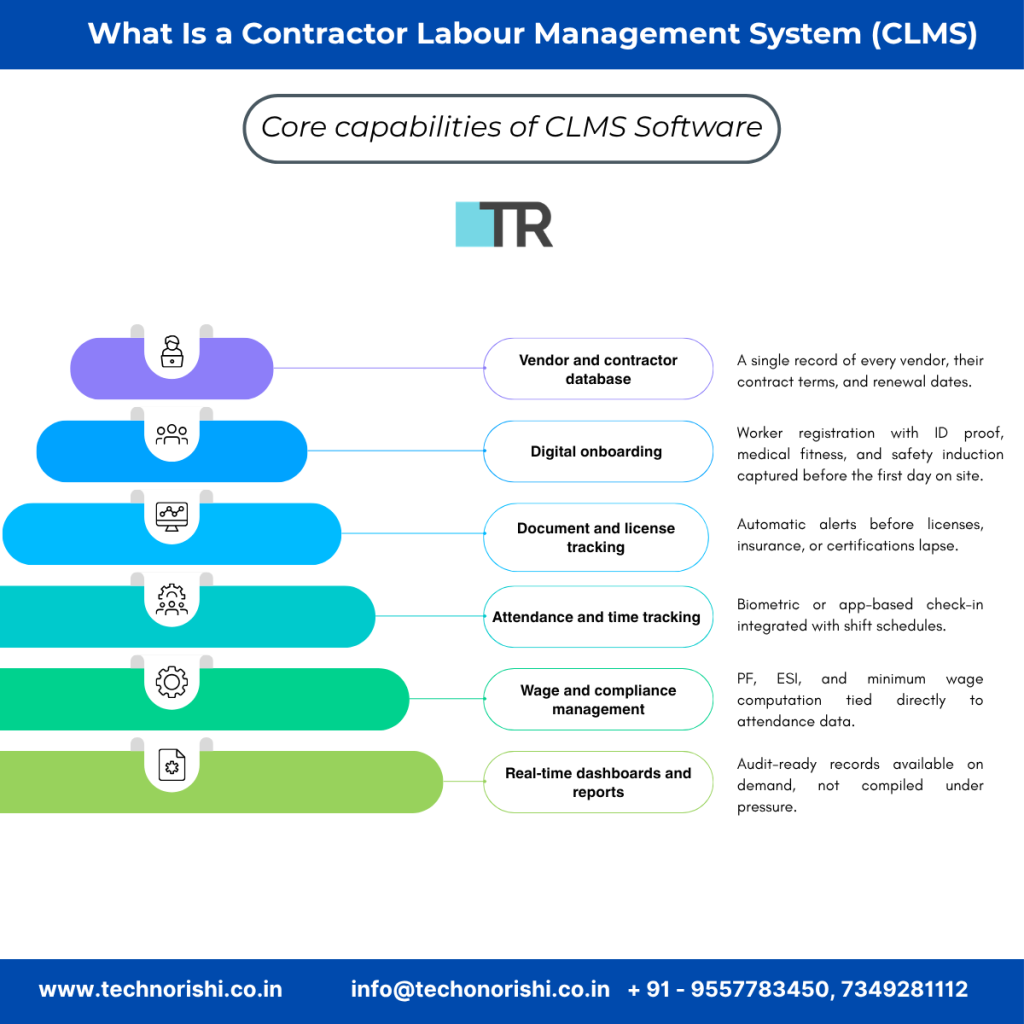
Core capabilities to look for
- Vendor and contractor database — A single record of every vendor, their contract terms, and renewal dates.
- Digital onboarding — Worker registration with ID proof, medical fitness, and safety induction captured before the first day on site.
- Document and license tracking — Automatic alerts before licenses, insurance, or certifications lapse.
- Attendance and time tracking — Biometric or app-based check-in integrated with shift schedules.
- Wage and compliance management — PF, ESI, and minimum wage computation tied directly to attendance data.
- Real-time dashboards and reports — Audit-ready records available on demand, not compiled under pressure.
How Contractor Labour Management Software Keeps You Compliant
The real value of this kind of system isn’t just convenience — it’s the reduction in compliance risk across every stage of the contractor lifecycle.
Standardised onboarding, every time – Manual onboarding varies from site to site and often skips steps under time pressure. A CLMS enforces the same checklist for every contractor and worker: verified documents, safety training, and background checks completed before system access or site entry is granted.
Always-current license and document status – Instead of relying on someone remembering renewal dates, the system flags expiring contractor licenses, worker IDs, and statutory registrations automatically, giving your team time to act before a lapse becomes a violation.
Accurate, traceable wage payments – Attendance data flows directly into wage computation, reducing disputes and ensuring PF, ESI, and minimum wage rules are applied consistently across vendors — a common point of failure when payroll is handled independently by each contractor.
Audit-ready reporting on demand – When a labour inspector or client audit team asks for records, a searchable digital trail of attendance, payments, and documentation replaces hours of manual compilation, cutting audit preparation time significantly.
Benefits of a Contractor Labour Management System for Manufacturing and Enterprises
Beyond compliance, a well-implemented CLMS changes how operations, security, and finance teams work day to day.
- Reduced administrative overhead — less time spent chasing paperwork across vendors and sites
- Better workforce visibility — know exactly how many contract workers are on-site at any moment, across every location
- Lower compliance risk — fewer missed renewals, wage errors, or incomplete records
- Improved vendor accountability — performance and compliance history tied to each vendor, informing renewal decisions
- Stronger site safety — no worker enters a facility without completed induction and valid documentation
- Faster payroll cycles — automated wage calculation reduces processing time and disputes
For manufacturing plants with rotating contract crews or BFSI offices managing outsourced facility staff, these gains compound quickly across multiple sites and vendors.
Choosing the Right Contractor Labour Management System
Not every CLMS is built for the scale or complexity of Indian compliance requirements. When evaluating a contractor labour management system, look for:
- Statutory compliance built for India — native handling of PF, ESI, and state-specific minimum wage rules, not a generic global template
- Integration with existing systems — connects with gate pass, HRMS, and facility management tools rather than operating as a silo
- Multi-site and multi-vendor support — one dashboard across all locations, not a separate login per site
- Mobile-first attendance — field and site staff need to check in from wherever they’re working
- Vendor self-service portals — contractors can upload documents and manage their own worker rosters, reducing back-and-forth
TechnoRishi’s Contractor and Labour Management System is built specifically around these requirements, with a digital Worker Work Pass for secure, verified site entry.
Frequently Asked Questions
1 – What is the difference between contractor management and labour compliance software?
Contractor management typically covers vendor onboarding and contract tracking, while labour compliance software focuses on statutory obligations like PF, ESI, and minimum wages. A CLMS combines both into a single platform.
2 – Can CLMS software integrate with existing HRMS or gate pass systems?
Yes — a well-designed CLMS is built to integrate with HRMS, gate pass, and facility management platforms so contractor data doesn’t sit in a separate silo from the rest of workforce operations.
3 – How does the software help during a labour department audit?
It maintains a digital, timestamped record of attendance, wage payments, and document verification, so the required registers and reports can be generated instantly instead of compiled manually under deadline pressure.
4 – What happens if a contractor’s license expires without renewal?
A CLMS sends advance alerts before expiry dates, giving the compliance team time to follow up with the vendor and avoid a lapse that could result in work stoppage or penalties.
Conclusion
Manual tracking simply can’t keep pace with the scale and regulatory complexity of managing today’s contract workforce. Contractor Labour Management Software gives your organisation a single, audit-ready system for onboarding, attendance, wages, and statutory compliance — replacing scattered registers with real-time visibility.
If your team is still relying on spreadsheets and paper files to manage contractors across sites, it’s worth seeing what a purpose-built system looks like in practice.
Book a free TechnoRishi CLMS demo and see how much easier compliance becomes when it’s built into the system, not bolted on afterward.