
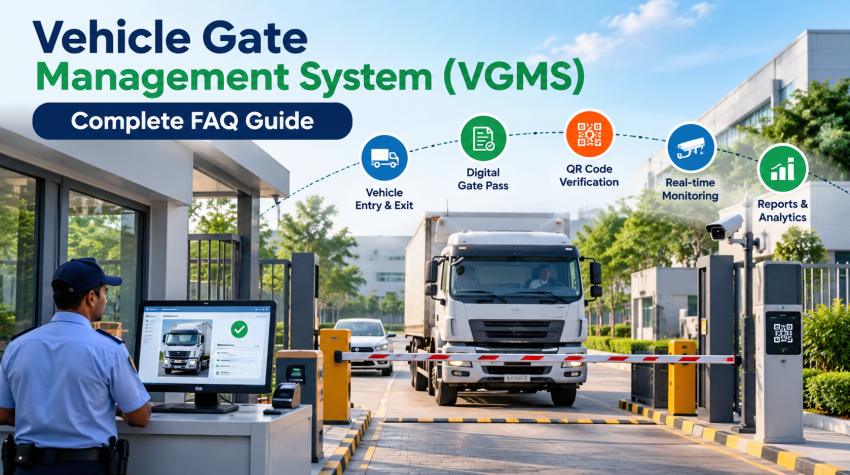
A Vehicle Gatepass Management System (VGMS) replaces paper registers and handwritten slips with a digital record of every vehicle that enters or leaves your premises. If your security team still checks trucks, vendor cars and company vehicles by hand, this guide answers the questions that operations, security and admin teams ask most often before they go digital.
In this FAQ guide, you will learn how a Vehicle Gatepass Management System works, which features matter, what it costs and how to roll it out without slowing down your gate.
What Is a Vehicle Gatepass Management System (VGMS)?
A Vehicle Gatepass Management System is software that creates, approves, verifies and records gate passes for vehicles. It captures who is arriving, which vehicle they are driving, why they are visiting and exactly when they enter and leave. Everything is stored in one searchable system instead of scattered registers.
Think of it as a digital gatekeeper. A guard no longer writes details by hand. The system generates a pass, routes it for approval and lets security verify it in seconds.
What is a vehicle gate pass?
A vehicle gate pass is an authorisation that allows a specific vehicle to enter or exit a facility. It normally records the vehicle number, driver details, purpose of visit, the person or department being visited and the validity period.
Why are manual gate pass registers a problem?
Paper registers worked when traffic was low. Today, they create avoidable risk and delay:
- Illegible or incomplete handwritten entries
- No live view of which vehicles are inside the premises
- Slow approvals when the approver is away from the desk
- Paper passes that can be copied, reused or forged
- Hours of manual work to prepare audit or incident reports
Consider a plant that receives over 100 trucks a day (an illustrative scenario). If each entry needs a phone call to confirm the visit, queues build up outside the gate and drivers wait with engines running. A digital gate pass system removes most of those calls because approvals happen before the vehicle arrives.
How Does VGMS Work? Step-by-Step Process
Every Vehicle Gatepass Management System handles vehicle entry and exit management in broadly the same way. The screens differ by vendor, but the logic stays similar.
- Request or pre-registration: A host, vendor or transporter raises a pass request with the vehicle number, driver name and purpose.
- Approval: The request goes to the right approver, who gets an email or mobile alert and can approve or reject it on the spot.
- Pass generation: The system issues a pass with a unique number and a QR code or barcode.
- Gate verification: The guard scans the code or enters the pass number on a tablet or phone. The system confirms the pass is valid for that vehicle, date and gate.
- Entry logging: Entry time, vehicle details and, if enabled, driver and vehicle photos are saved automatically.
- Exit and closure: Exit time is recorded and the pass is closed. For returnable material, the guard checks that the load matches the pass.
- Reports and audit trail: Managers see live dashboards and download logs by date, gate, vendor or vehicle.
Can it work with ANPR cameras, RFID readers or boom barriers?
Many platforms can integrate with automatic number plate recognition (ANPR) cameras, RFID readers and boom barriers, so the barrier opens only for approved vehicles. Integration depends on the vendor and the hardware you already own, so confirm this before you buy.
Can guards use it on a mobile phone or tablet?
Yes. Most modern vehicle gate pass software runs in a web browser or mobile app, so guards can verify passes on a tablet, a phone or a gate-side desktop. Choose a screen that is simple enough for a guard to use in under a minute during peak hours.
Must-Have Features in Vehicle Gate Pass Software
Not every business needs every feature. When you compare any Vehicle Gatepass Management System, use this list to shortlist what matters for your gate:
- Pre-registration and online requests: Let vendors and employees request passes before arrival.
- Multi-level approval workflow: Route passes by department, vehicle type or material value.
- QR code or barcode verification: Make each pass hard to copy and quick to check.
- Live vehicle dashboard: See which vehicles are inside right now and for how long.
- Photo capture: Store driver and vehicle images with the entry record.
- Blacklist alerts: Flag vehicles or drivers who are not allowed to enter.
- Automated notifications: Alert hosts by email, SMS or app when a vehicle arrives.
- Returnable and non-returnable material tracking: Link goods to the vehicle carrying them.
- Role-based access: Give guards, approvers and admins only the permissions they need.
- Reports and exports: Filter and download records for audits and reviews.
As a rule of thumb, a single-gate unit can start with pre-registration, QR verification and reports. A multi-gate plant should also look at approval workflows, analytics and integrations. Whatever you pick, test it with your own guards and your busiest shift before you sign, because a feature that looks good in a demo can feel slow at a crowded gate.
Can one system manage multiple gates and locations?
Yes. A centralised Vehicle Gatepass Management System lets each gate run with its own guard login while head office views consolidated data from every site. This makes it easier to apply one policy across plants, warehouses and offices.
Key Benefits of a Digital Gate Pass System
Moving from paper registers to a Vehicle Gatepass Management System changes how your gate performs every day. The main benefits are:
- Faster clearance: Pre-approved passes reduce waiting time and queues at the gate.
- Stronger security: Only vehicles with a valid, verified pass get in.
- Accurate records: Data is entered once and cannot be quietly changed or lost.
- Clear accountability: Every approval and gate action is tied to a named user and a time.
- Less paper and rework: No bulky registers or manual data entry for reports.
- Better planning: Dock, yard and parking teams can see arrival patterns and plan space.
A Vehicle Gatepass Management System also helps you plan. Arrival data shows which hours are busiest, which vendors are repeatedly late and how long vehicles stay inside. Yard and logistics teams can use this to stagger deliveries and cut idle time. Digital records also speed up investigations. If material goes missing, you can trace which vehicle left, who approved the pass and at what time, without searching through old registers.
Which industries need a Vehicle Gatepass Management System?
Any site with regular vehicle movement can benefit. Common examples include manufacturing plants, warehouses and logistics hubs, automotive facilities, hospitals, hotels, corporate campuses, construction sites and educational institutions.
Who benefits inside the organisation?
Security teams get an easier job at the gate. Admin and facility teams get cleaner records. Stores and purchase teams gain control over inbound and outbound material. Management gets reliable data for audits.
Cost, Implementation and Compliance FAQs
How much does a Vehicle Gatepass Management System cost?
Pricing depends on the number of gates, users and modules, whether you choose cloud or on-premise deployment, and what hardware you need, such as scanners, cameras or barriers. Most vendors quote after a short requirement discussion. Ask what the quote includes: licences, hardware, training, customisation and support. Comparing at least three quotes on the same scope makes the numbers much easier to judge.
How long does implementation take?
Timelines depend on scope. A single gate with a standard workflow can usually go live faster than a multi-site rollout with integrations. A typical project moves through requirement mapping, configuration, training, a pilot at one gate and then full go-live.
Is vehicle and driver data safe, and what does the law say?
Driver names, phone numbers and photos are personal data. India’s Digital Personal Data Protection Act, 2023 sets rules on notice, consent and safeguards for processing digital personal data, and the Ministry of Electronics and Information Technology publishes the official framework. Look for role-based access, encrypted storage, audit logs and a clear data retention policy. Many buyers also use ISO/IEC 27001 as a benchmark for a vendor’s information security practices. Check with your legal team for requirements specific to your business.
How do we get guards to adopt it?
Keep training short and hands-on. Pilot the Vehicle Gatepass Management System at one gate, run the old register in parallel for a week or two, and gather feedback from guards before you expand. Simple screens and large buttons matter more than extra features.
Frequently Asked Questions (FAQs)
What is the difference between a gate pass and a visitor pass?
A gate pass authorises the movement of a vehicle or material. A visitor pass identifies a person. Many sites use both, and a Visitor Management System can work alongside vehicle gate pass records so security sees the full picture at the gate.
Can a VGMS track returnable material?
Yes. Good systems let you link material to the vehicle’s pass, mark it as returnable or non-returnable and flag items that have not come back by the due date. This also supports documentation for goods movement, such as e-way bills where they apply.
Is a Vehicle Gatepass Management System only for large companies?
No. Small plants, warehouses and campuses with a single gate also gain from faster entry and cleaner records. Start with core features and add modules as traffic grows.
Does it replace security guards?
No. A Vehicle Gatepass Management System supports them. Guards still check vehicles and handle exceptions, but the software removes paperwork and gives them accurate information.
Can it handle contractor and vendor vehicles?
Yes. Contractor vehicles can be pre-registered with validity dates. If you manage contract workers, pair the system with a Contractor Labour Management System so people and vehicles are controlled together.
Can it integrate with ERP, HRMS or other software?
Many platforms offer APIs or ready connectors to share data with ERP, HRMS and security systems. Ask which integrations are standard and which are custom work, because custom work adds time and cost.
Does it need an internet connection?
Cloud-based systems need internet access at the gate. On-premise systems can run on your local network. Ask the vendor how the system behaves if connectivity drops.
Conclusion: Make Your Gate Smarter with VGMS
A Vehicle Gatepass Management System replaces paper registers with fast approvals, verified entry and a complete audit trail. It reduces queues, strengthens security and gives your team data they can trust. Start by mapping how vehicles move through your gates today, then shortlist the features that solve your biggest gaps.
TechnoRishi’s Gate Pass Management System is part of a wider suite that serves manufacturing, automotive, hospitality and other sectors, alongside our Facility Management System (FMS). Ready to digitise your gate? Visit www.technorishi.co.in and book a demo with our team.